All-through school vs prep school: which is right for your child?
By Annabel Dunstan - Cambridge university educated writer and education expertBoth routes – all-through schools and separate prep and senior schools – have their merits, and each option appeals to different families in different ways. In this article, we explain the pros and cons of both. With expert insight from James Fowler (Vice Chair of the Advisory Board, Inspired Learning Group), we break down the reasons why each route works, and highlight the things you might want to consider – helping you make an informed choice for your child.

In the UK independent sector, there are some prep schools, some senior schools, and some ‘all-through’ schools, which are both prep and senior. Your child will be in education from the age of four to the age of eighteen – but it’s up to you whether they spend all that time in one school, or whether they switch (and if so, when!). Both routes – all-through schools and separate prep and senior schools – have their merits, and each option appeals to different families in different ways. In this article, we explain the pros and cons of both. With expert insight from James Fowler (Vice Chair of the Advisory Board, Inspired Learning Group), we break down the reasons why each route works, and highlight the things you might want to consider – helping you make an informed choice for your child.
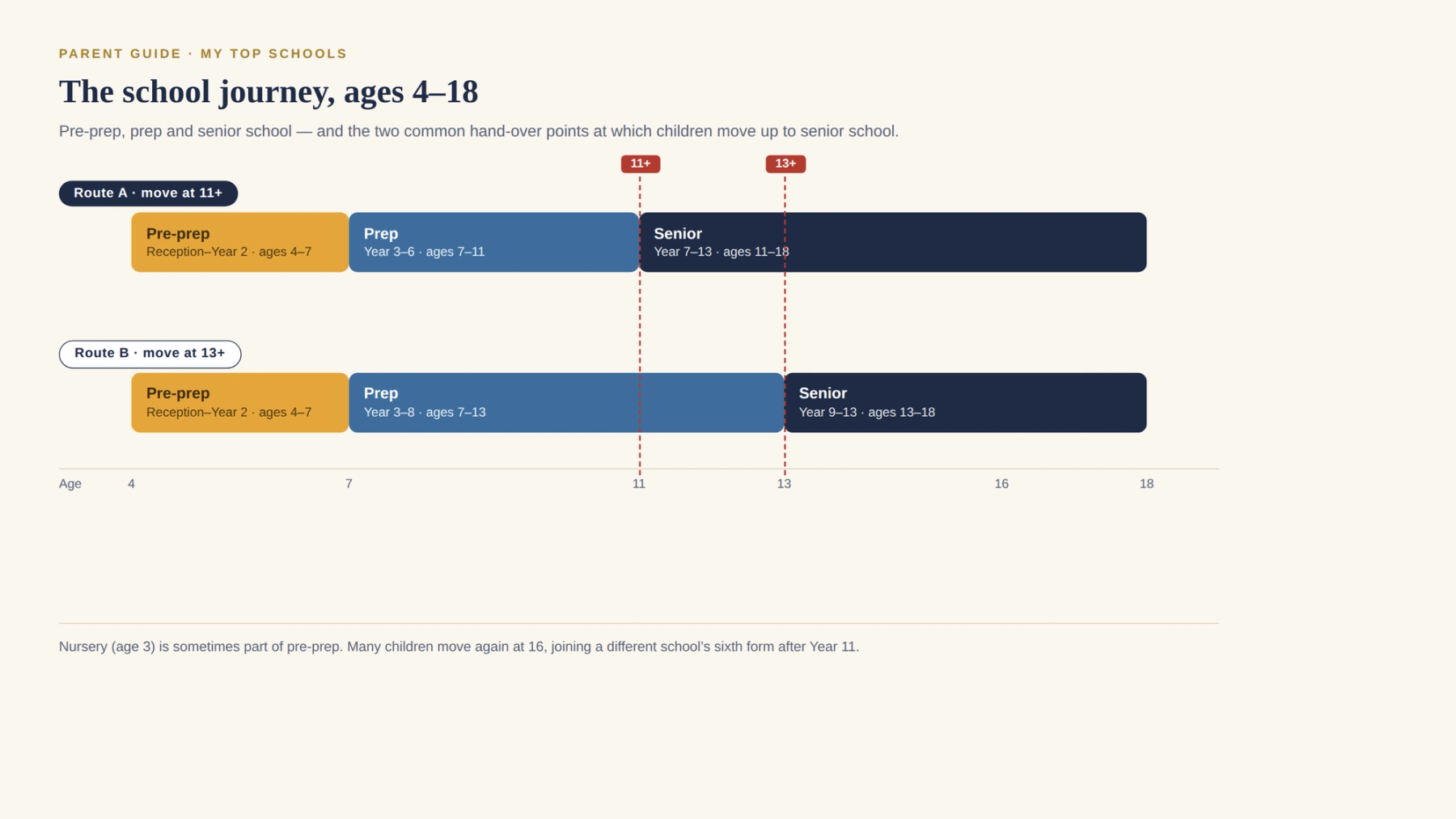
Pre-prep, prep and senior school: ages and year groups explained
To begin with: we’ll be referring to ‘prep’ and ‘senior’ education throughout this article, and we want to be really clear which year groups and ages are included in those brackets. School websites can often be unhelpfully vague on this – so let’s nail down the key terms before we set off.
Pre-prep: encompasses school years Reception to Year 2, which is ages 4-7. Sometimes, pre-prep includes nursery, which takes children aged 3.
Prep: either Year 3 to Year 6 (which is ages 7-11), or in some schools, Year 3 to Year 8 (ages 7-13).
Senior: either Year 7 to Year 13 (ages 11-18) or Year 9 to Year 13 (ages 13-18).
Sometimes children can remain in school until they are 19, for example if they have been held back an academic year, or if they attend a specialist SEND school that offers Year 14.
As you can see from the list above, there are few common transition points. Children move from pre-prep to prep at the end of Year 2, aged 7. They can transition from prep to senior at two possible points: either after Year 6 (aged 11) or after Year 8 (aged 13) – and we’ll talk later about how to choose between the two. Finally, it’s worth noting that although ‘senior school’ is all one phase, children commonly move to a new school after Year 11 (aged 16), to join the sixth-form somewhere different.
How do all-through schools and linked prep schools differ?
At this juncture, we should also point out that there are some exceptions to the ‘all-through’ and ‘separate’ categories of school. Some all-through schools function almost separately: they might have different buildings, slightly different uniforms, or even a different Head for prep and senior. On the other side of the coin, some separate prep schools are linked up with senior schools such that you can transition smoothly between them – giving them the connected character of an all-through school. Inspired Learning Group have many joint schools of this nature.
What are the academic benefits of an all-through school?
So why might you choose an all-through school for your child? The biggest factor in favour of an all-through education is continuity. Staying at one school for your whole education has some advantages academically: the whole journey through school is connected, and the thinking is joined up between each phase. Learning builds from year to year without gaps or repetitions – because all the staff are working to the same curriculum plan, and they all know exactly what your child has learnt already. In addition, an all-through school is likely to have a consistent assessment style throughout each phase of education. Although tests and assessments will always evolve and mature with the child, a school will have its own standards, metrics and systems for measuring progress and attainment. It can be easier to keep track of your child’s academic journey when these systems remain the same.
Pastoral care and friendships: the benefits and drawbacks of continuity
Children at all-through schools also benefit from pastoral continuity. Care can be more tailored when your child has been known for their whole developmental journey; teachers and support staff can get to know them well over an extended period, and nurture them through multiple stages of life. Many families take comfort in knowing that their child will never have to start over again with these relationships. This applies to peer relationships too: lots of children find secure and fulfilling friendship groups during the prep phase, and the thought of starting afresh in Year 7 amongst a completely new crowd can be very daunting (for the child and for you as parents!). The benefit of an all-through school is that your child can move up with the same group of people. As James Fowler articulates:
“All-through education can give children confidence, especially those who might be nervous about their school or their surroundings. Knowing that the friendship groups they establish early can be kept throughout the school may help.”
The counter-argument is that sometimes a change in peer group can be healthy. Even though we’d all like to imagine that our child will start school in Reception and immediately find their forever friends, if we’re honest with ourselves we know that this is rarely the case in reality. Children change and friendships change; relationships aren’t always settled by the end of prep school. Even if your child does make great friends, fourteen years is a long time to spend with the same group of people. Even the nicest classes can become melting pots after a while – sometimes some fresh faces are exactly what’s needed!
Parents often feel that they would value being part of one school community for their child’s whole education. Undeniably, this has great merits: your family becomes known to the school and to other families, and you get a real sense of belonging within the school ecosystem. Do remember, though, that seven years or five years in a senior school (or even just two years in the sixth-form!) is still long enough to build community and stability. If you want to throw yourself into the community of a school, you will be able to find your place.
Do all-through schools avoid 11+ entrance exams?
Another key benefit of an all-through school is that everyone usually moves up to the senior stage automatically – without needing to sit an exam or go through an applications process. Senior school entrance exams can be competitive and intense; many families want to keep their children free from this pressure for as long as possible. There will be plenty of exams coming their way in the senior school, so why put them through it aged 11? Additionally, these exams require taught preparation. Having no exams at the transition point means that the curriculum is more free to focus on other learning, rather than rigorously focusing on test readiness. As James Fowler agrees:
An all-through school guarantees the ability to transfer smoothly between primary and secondary without any hiatus at 11+. For some families this can be one of the most demanding experiences, so having that as something which does not cause anxiety may be very important.”
One thing to bear in mind, of course, is that the seamless transition is only an advantage if you do intend to keep your child at the same school. If you start them off at an all-through school but decide to move them to a separate senior school later, they will be the odd one out preparing for their entrance assessments!
How do standalone prep schools prepare children for senior school?
So why would separate prep and senior schools be a good route to choose? Well, prep schools are called ‘prep’ because of their focus on preparing for entry assessments to selective senior schools. This exam focus puts some parents off – as we discussed earlier – but when your child attends a dedicated prep school, they are in the same boat as everyone else. Everyone in the year group is working towards the same goal and experiencing the same journey. Application to senior school can be a challenging time – there’s no doubt about it – but there is great solidarity and support to be found when everyone in your school community is doing it together. Moreover, it could be said that this route provides better preparation overall for senior education, which is highly assessment-driven. Your child will have to sit formal exams in Year 11 whether they like it or not, so there’s a strong argument in favour of the separate prep system, which gets them used to assessments early.
Why choose separate prep and senior schools? Flexibility and school fit
An undeniable benefit of choosing separate prep and senior schools is the flexibility it enables you. Your child will change a great deal throughout their school career. It might be hard to imagine now, but over the course of the coming years your wide-eyed, baby-faced little girl or boy will transform into a fully-fledged young woman or man. Can you really tell at the age of four what they will need and want at the age of sixteen plus? James Fowler explains the advantage of flexibility very clearly:
“Knowing what a child will need later in their development is tricky. Many children develop in interesting ways during their primary years, perhaps finding new interests in particular sports or cultural activities, let alone finding their proper place in the academic hierarchy. Senior schools are undoubtedly diverse in their approach and specialisms, and finding the right one for your child can be a demanding business – but it is certainly easier when the child is rather older!”
Can changing schools build confidence and resilience?
Another point to think about is that change is healthy and important. Moving to a new school and meeting new people is not only helpful and refreshing for your child at the time, but it also equips them with valuable social skills that will last for life. The ability to settle into an unfamiliar environment, adapt to change and forge new relationships will stand them in good stead for entering further study and the world of work, where they will have to change location and meet new people. Lots of parents fear that their son or daughter won’t be able to make friends in a new place – and that’s completely understandable – but when your child is joining a senior school from a separate prep school, they are rarely the only new person. Every child is in it together, and they find their way side by side. As well as discovering new relationships, choosing separate prep and senior schools allows your child to explore a new place. Rather than being cushioned in the same spot for their whole childhood, they get a broader experience of different settings and different ways of doing things, which grows their resilience and adaptability.

Leadership opportunities and childhood: the standalone prep school experience
One final reason that parents choose separate prep and senior schools is that it enables their children to experience the full school life cycle. What do we mean by this? Well, at the risk of stating the obvious, when children reach Year 6 (or Year 8) in a standalone prep school, they are the oldest year group in the school. Being at the top of the school is a fulfilling experience – some would argue a rite of passage – because children have the chance to be seen as mature, trusted role models before they move on to their new school and rejoin at the bottom of the tree. Many prep schools offer the roles of prefects, tour guides or house captains at this stage. Some describe this phenomenon as being ‘a big fish in a small pond’ – and the all-through experience can’t replicate it. Linked to the school life cycle, many parents would prefer to protect their younger children from the teenage issues and influences of the senior stage. Whilst it can be beneficial and inspiring to have much older role models when you are young, it can also cause children to grow up faster.
11+ or 13+ entry: when should your child move to senior school?
So you’ve decided to choose separate prep and senior schools for your child – but when should they make the transition between the two? 11+ or 13+? There are arguments on both sides. Moving at 11+ (after Year 6) is increasingly the standard transition point. Testing is more intense at this stage, but it matches the progression of the state sector. Parents often favour the 13+ transition because it prolongs childhood, allowing children to stay ‘younger’ for longer and experience the nurture of a prep school during their crucial early puberty years. However, given that most students now are transitioning at 11+, leaving it until 13+ to switch could mean that your options are more limited. Spaces will already have been filled. It’s always worth considering when the rest of your child’s cohort is moving; you may want to match up their transition to the rest of their year group, rather than rip them away early or try to integrate them late. That said, moving at a different time to everyone else is not the end of the world. Plenty of children end up having to move schools mid-stage, because of moving house or other changing circumstances, and these children always find a way to integrate and make friends in the end.
Here are James Fowler’s thoughts on transition points:
"The 13+ transition was for many years the traditional route, with obvious merits in allowing a child to have more time for development before beginning the demanding process of senior schooling. The 11+ transition does of course reflect the general picture nationally, and after 7 years of primary schooling it provides a natural point at which to move to a more grown-up form of schooling for the next 7 years.
I also believe there is real enjoyment to be had in the KS3 years (age 11-14), when for the last time most children will follow a common curriculum, share the same excitements and challenges, and be able to grow up together as young teenagers. A move at 11+ puts this in place."
Our overall advice is to think about what your child needs as an individual – aside from what everyone else is doing. Would your child benefit from a little longer in their current place? Or are they ready for a change? You know your child the best; trust your instincts.
How to choose between all-through and separate schools:
Key Takeaways
- All-through schools are a good choice if you would value academic and pastoral continuity, as well as an exam-free route.
- Separate prep and senior schools are a good choice because they allow flexibility, healthy change and the building of resilience.
- What kind of school your child attends – and if you choose separate prep and senior, at what point they move up – should depend on the child’s needs and circumstances. Best fit is key!